

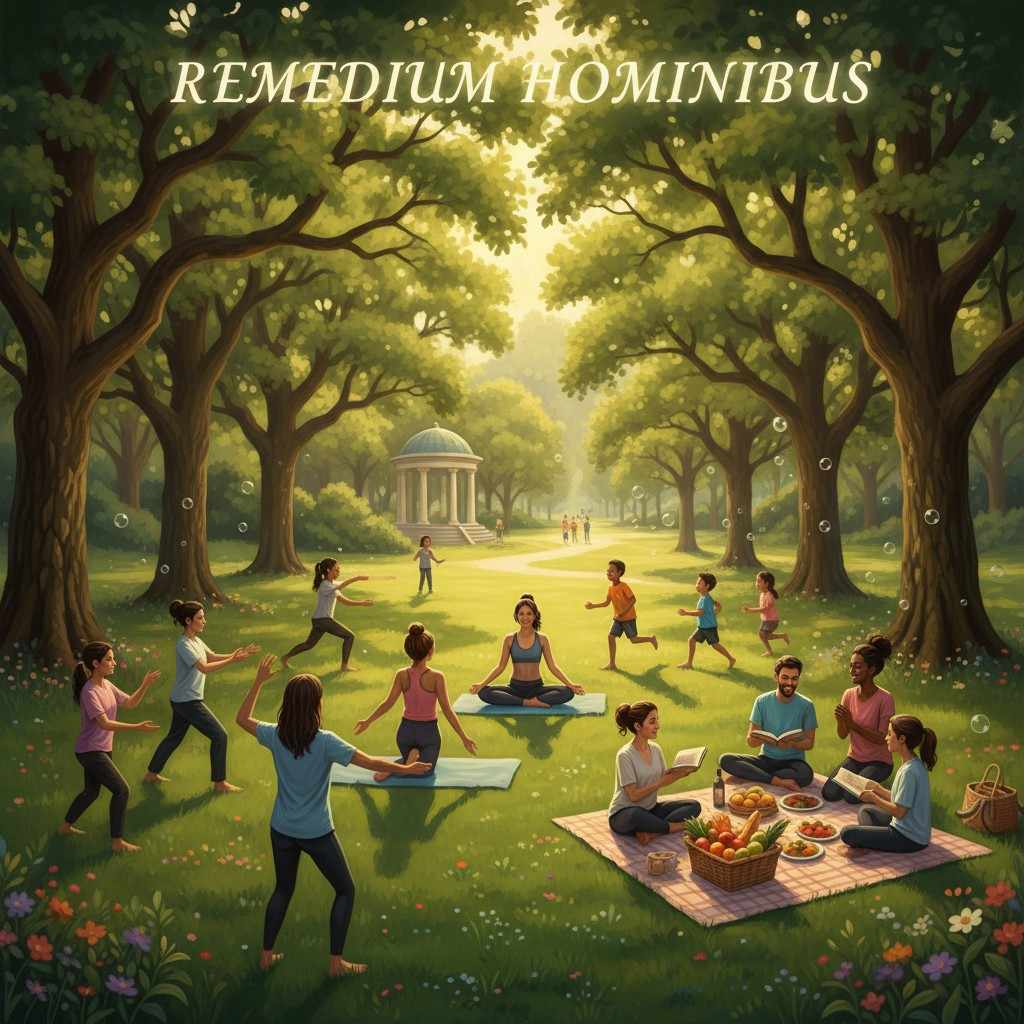
Two Latin words. Four syllables each. Together, they carry a weight that philosophers, storytellers, and institutions have reached for across centuries: remedium hominibus — a remedy for humanity.
The phrase has resurfaced in popular consciousness partly through the Apple TV+ series Severance, where it serves as the motto of the fictional Lumon Industries. But strip away the corporate dystopia, and the phrase asks something genuinely profound: what does it mean to heal people? Not one person, not a community — but humanity as a whole. That question is old, and the answers we give to it shape everything from how we design institutions to how we live our daily lives.
This post unpacks the phrase, traces its conceptual roots, and explores what “a remedy for humanity” might look like in practice.
What Does Remedium Hominibus Actually Mean?
The Latin is straightforward. Remedium — the 1,111th most frequently used word in classical Latin, according to the University of Chicago’s Logeion database — means “that which heals again; a cure, remedy.” It appears in writers from Lucretius to Tacitus, covering everything from medicinal treatments to emotional relief. The Lewis & Short Latin dictionary defines it broadly as “a means of aid, assistance, or relief.”
Hominibus is the dative plural of homo, meaning “for humans” or “for mankind.” Put them together, and you get a phrase that functions grammatically as a purpose statement: a remedy intended for people.
What makes the phrase interesting isn’t just its translation — it’s the tension built into it. A remedy implies something is broken. To position a cure “for humanity” is to make a sweeping claim about what ails us collectively, and to take on the responsibility of fixing it. That’s either an act of profound compassion or extraordinary arrogance, depending on who’s wielding the phrase and why.
Historical Roots: Healing as a Human Ideal
The impulse behind remedium hominibus predates the Latin words themselves. Ancient Greek medicine, rooted in the Hippocratic tradition, treated healing as both a science and a moral obligation. Physicians weren’t just practitioners — they were stewards of human wellbeing. The idea that medicine existed to serve people, not the other way around, was foundational.
Roman writers extended this beyond the physical. Seneca, one of the most prolific users of remedium in classical literature, applied the concept to emotional and philosophical suffering. In Letters to Lucilius, he treats philosophy itself as a form of medicine — a remedy for anxiety, grief, and the fear of death. For Seneca, remedium was as much about the mind as the body.
This dual meaning — physical cure and spiritual or philosophical relief — is what gives the phrase its enduring resonance. It refuses to separate the treatment of bodies from the treatment of souls.
Core Principles: What a “Remedy for Humanity” Requires
If we take remedium hominibus seriously as an ideal, a few principles emerge.
It must be oriented toward the common good. A remedy that benefits only the powerful isn’t a remedy for humanity — it’s a remedy for the privileged. Genuine healing requires attention to those who suffer most, not those who shout loudest.
It must acknowledge what’s actually broken. You can’t prescribe a cure without an honest diagnosis. Many well-intentioned efforts to “fix” people or societies fail because they treat symptoms rather than causes. Effective remedies require clear-eyed assessments, not wishful thinking.
It must respect the recipient. This is where the phrase gets complicated. History is full of institutions that claimed to offer remedium hominibus while stripping people of their autonomy in the process. As the Severance wiki notes, Lumon’s motto could mean “curing humanity of all its ills” — but it might equally imply “curing humanity of troublesome emotions altogether.” The difference between healing and control is not always obvious to the healer.
Why It Matters Now
Several converging pressures make this concept newly relevant.
Mental health crises are accelerating globally, and conventional systems are struggling to keep up. Loneliness, burnout, and anxiety are now discussed in public health terms — not as individual failures, but as collective conditions requiring collective responses. The idea of a remedy for humanity has moved from philosophical abstraction to operational urgency.
At the same time, technology companies, governments, and institutions frequently invoke the language of healing and wellbeing to justify interventions of sweeping scale. Knowing how to evaluate those claims — to ask who benefits, who decides, and at what cost — is a practical skill, not just a philosophical one.
The phrase also offers something quieter: a reminder that the impulse to help, to cure, to relieve suffering, is deeply human. It predates capitalism, predates nation-states, predates most of the institutions we now take for granted. That impulse doesn’t need to be grand or institutional to be meaningful.
Practical Applications in Daily Life
You don’t need to run a pharmaceutical company or draft public health policy to engage with remedium hominibus. The concept scales down.
- In personal relationships: Asking what someone actually needs before offering advice or solutions is a form of applied remedium. Listen for the root cause, not just the surface complaint.
- In professional contexts: Designing products, services, or processes with genuine user wellbeing in mind — rather than engagement metrics or convenience — aligns with the principle’s better interpretation.
- In community engagement: Volunteering, mentoring, or contributing to mutual aid networks are tangible expressions of the idea that we owe each other something beyond transactional exchange.
- In self-care: The concept applies inward, too. Recognizing your own need for rest, reflection, and support isn’t weakness — it’s a prerequisite for any sustained effort to contribute to others.
Small acts don’t cure humanity. But they do compound. Communities built from a genuine orientation toward the wellbeing of others are more resilient, more creative, and more equitable than those built purely on competition or compliance.
Looking Forward
The future of remedium hominibus as an ideal depends on whether it remains in the hands of those who are accountable to the people they claim to serve. Institutions that use healing language while centralizing power tend to corrupt the concept entirely. The antidote is transparency, participation, and a genuine willingness to be corrected.
There’s also something to be said for humility. The greatest healers in history — medical, philosophical, social — tend to share a recognition that they don’t have all the answers. They remain curious, adaptive, and attuned to feedback. A remedy that stops listening stops working.
The Phrase Is a Question, Not an Answer
Remedium hominibus is most useful not as a motto to be stamped on license plates or corporate letterheads, but as a question to be asked continuously: what would actually help people, and are we doing that?
The Latin carries centuries of weight — from Seneca’s philosophical letters to the examining rooms of Roman physicians to the cultural conversations sparked by contemporary storytelling. Across all those contexts, the phrase points in the same direction: toward care, toward honesty, and toward the belief that human suffering is not inevitable and not acceptable.
That belief, wherever it takes root, is itself a kind of remedy.
